This week we are talking about makerspaces!
This assignment was an interesting challenge because we already have a makerspace at our elementary school (which serves kindergarten through fifth grade). Students use a 3D printer, grow tomatoes and conduct other science experiments at the makerspace. That instruction is run by the STEM teacher in a separate area from the library.
That said, I don’t think students can have too much hands-on learning or experience with making. Our school has a specific focus on STEM, so I would like to have work done in the library that helps highlight the library’s role in STEM education. I chose to focus on newer technology rather than lower-tech options, since we are so STEM-focused.
As a part of this class assignment I get to imagine what I would do with a maximum $3,000 to make a makerspace in my library.
The idea
Next year is a special anniversary of our school’s founding, and I am starting to think of ways we could celebrate the milestone, while helping our students learn about local history. I recently enjoyed listening to a podcast episode where Rhonda Jenkins (our State Librarian of the Year in 2023) talked about having her elementary school kids make a podcast together where they interviewed different people around the school.
I want to use this imaginary $3,000 grant to give my students the tools they need to make multimedia content (a podcast with video) about our local history and community! This will definitely incorporate technology into library instruction in a meaningful way, and can be paired with online and print library resources from both our school library and our nearby local library.
This will also be a great way for us to leverage the nearby community makerspace at our public branch library (which is literally next door). We can head there to edit the audio and video we record, since they have a multimedia booth with editing software. My students also have access to Canva on their chromebooks, so we can make a cool logo and graphics to go along with the podcast!
My goal here is to get students learning about their community, developing research questions (what do I want to know about our school or community?), researching and creating something to synthesize what they learn. This fits in well with ITSE Standard 1.6 “Creative Communicator: Students communicate clearly and express themselves creatively for a variety of purposes using the platforms, tools, styles, formats and digital media appropriate to their goals.”
I also may be a little biased in that I come from a journalism background, so doing something like this is exactly how I would’ve loved to learn as a kid!
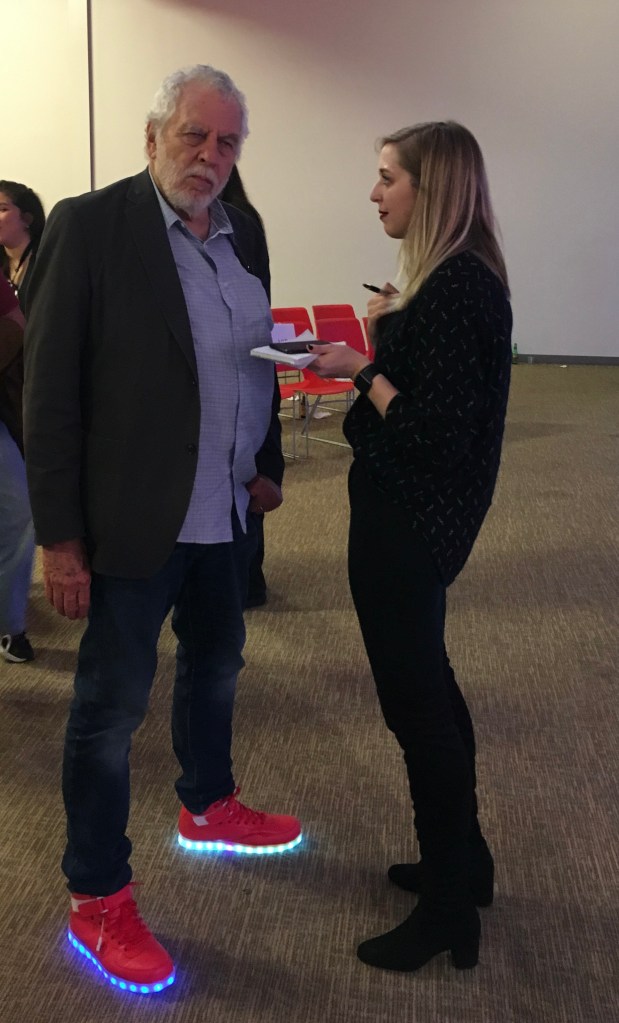
Me (on right) many years ago interviewing Nolan Bushnell (left), founder of Atari and Chuck E. Cheese.
Where and how
Our supplies will live on a rolling maker cart so that I can roll it behind my desk when we are not working with the supplies, and then roll it out for checkout time and instruction.
Half of the equipment will be available to teachers or older students (5th grade) for check out, and half of the equipment will live in the library for instruction. Younger grades will do their work in a guided fashion in the library or with their teacher.
Since this is a one-time grant, I deliberately chose a proposal that did not have a lot of consumables. The only consumables I’m getting to jumpstart student excitement and get them feeling like reporters, is to get a pack of top-flip notebooks and some golf pencils for notes.
Click here to check out the budget I developed for this idea!
Tell me what you think in the comments below! Have you done something like this with your class before? Feel free to share!
 The Queer Librarian
Leave a comment